
Israel has for more than two decades and several US presidencies worked to draw the United States into a full-scale war with Iran. Having finally achieved that, the last thing it wants is Trump declaring victory and going home, as he is prone to do. Ali Larijani was the figure most capable of handing Trump a negotiated exit with something to show for it. Without Larijani, the road to an exit gets considerably narrower. Prem Panicker continues his must read daily blog on the Gulf War.

If Xi Jinping can establish control over the PLA Ground Force, relations between India and China will settle down to an even keel. The next few weeks will show whether Xi has finally succeeded in gaining control over the PLA Ground Force. That could bring about the substantive shift in India-China relations that both our leaders have been working for, observes Ambassador Prabhat Shukla.

The purge in Washington does not pause the war. Strikes continue, Hormuz remains closed, and Brent crude is still dancing around $109 a barrel. For India, the command chaos in the Pentagon is another layer of uncertainty piled on five weeks of conflict that was already straining every buffer Delhi has.

In the Indo-Pacific's new era -- where perception shapes reality faster than treaties -- the real entrapment is not of China or the United States. It is the test Japan has set for itself -- and whether partners like India, acting as balancers rather than accelerants, can help ensure that the story ends in stability, points out Varun Arya.
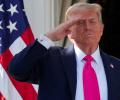
President Trump says the US is close to a trade deal with India, while also claiming to have stopped a war between India and Pakistan.

'As the PLA higher command is almost dismantled and instability spreads, India needs to be prepared for any eventuality,' cautions China expert Srikanth Kondapalli.
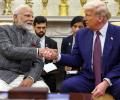
Trump went on to say that "I'm using trade to settle scores and to make peace."

Indian equity markets experienced a volatile trading day, with the Sensex and Nifty closing almost flat. Market sentiment was influenced by global cues, US-Iran talks, and profit-booking activities.

Congress leader Rahul Gandhi accused Prime Minister Narendra Modi of halting military conflict with Pakistan within five hours of being asked by then US President Donald Trump. He made the allegations during a rally in Muzaffarpur, Bihar, also criticizing the media and the deletion of names from electoral rolls.
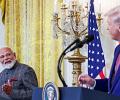
Prime Minister Narendra Modi and US President Donald Trump have vowed to move forward with plans to work together to build US-designed nuclear reactors in India. The decision was made during their meeting at the White House, where they also agreed to significantly expand energy cooperation. The move comes after India announced plans to amend its nuclear liability law and the Atomic Energy Act, which had previously been obstacles to the implementation of the US-India civil nuclear deal.

Although the credit for acquiring the technological skill must be given to India's outstanding nuclear scientists, the decision to go nuclear was a political one that entailed clarity of vision, courage and resolve, points out Rup Narayan Das.

Meanwhile, Trump said Cambodia and Thailand have started fighting again and "tomorrow", he will make a phone call to those countries.

Operation Sindoor compelled Pakistan to undertake constitutional amendments, which is an acknowledgement that things did not go well for the neighbouring nation, Chief of Defence Staff General Anil Chauhan has said.

The Indian government has come out with a nice name for its tried and tested 220MW pressurised heavy water reactor -- Bharat Small Reactor.

A senior leader of the ruling Pakistan Muslim League-Nawaz (PML-N) on Wednesday claimed that the military operation against India was designed under the supervision of the party president Nawaz Sharif.

Presenting the Union Budget, Sitharaman announced that the government will partner with the private sector to set up Bharat Small Reactors and in the research and development of small modular reactors.

AAERB's permission for RAPP-7 paves the way for the subsequent phases of reactor commissioning leading to its commercial electricity generation.

The ceasefire is still technically holding, to the extent that no overt hostilities have been reported yet, but the rhetoric has hardened dangerously. The week ahead will also clarify whether the Islamabad failure was a negotiating tactic or whether Washington has genuinely locked itself into a position from which the only exits are climb-down, escalation, or the slow bleed of a new status quo that nobody chose and nobody controls. Prem Panicker continues his must read blog on the Iran War.
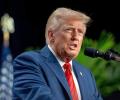
Trump said that leaders in India and Pakistan are "great leaders" and "they understood, and they agreed, and that all stopped".

Egypt, Pakistan, Saudi Arabia and Turkey met in Islamabad in what analysts say is the formal opening of a new diplomatic formation that could reshape the post-war regional order. Their immediate goal is a ceasefire; their larger ambition is to ensure that neither Iran nor Israel emerges from this war in a dominant position. Pakistan's foreign minister then flew directly to Beijing and mooted a Chinese role as guarantor of any eventual agreement. Prem Panicker continues his must read daily blog on the Gulf War.

The idea of back-loading the target of fiscal consolidation is perhaps guided by the government's desire to be prepared for any adverse developments in the coming year, points out A K Bhattacharya.

Israel and the United States had a plan. Iran punched back. And now the Gulf is reeling, the world is beginning to feel the pain and, as on date, no one in Washington or Tel Aviv appears willing to admit that the punch has landed, notes Prem Panicker, continuing his must-read blog on the war in the Middle East.

Iran is fighting a different war: Older, slower, and in some ways more dangerous. Iran doesn't need to shoot down an F/A-18. It only needs to make the Strait of Hormuz feel dangerous long enough for insurance markets, shipping companies, and oil futures traders to do the rest. Prem Panicker continues his must-read daily blog on the war in the Middle East.
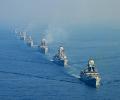
A parliamentary panel on external affairs has expressed concern over China's growing presence and influence in the Indian Ocean Region, citing risks to India's national security and strategic interests. The panel also highlighted the strengthening China-Pakistan naval nexus as a cause for concern.
'The real story of 2025 is that India officially stopped being a 'market of the future' and started acting as the world's primary economic engine.'

India on Thursday said the issue of trade did not come up at all in talks between Indian and American leaders during its military clashes with Pakistan, virtually rejecting Washington's repeated claims that its offer of trade stopped the confrontation.

The country is planning to increase its nuclear power generation by about 60,000 mega watts (Mw) within the next 25 years. This planned capacity addition is being executed by the state-owned Nuclear Power Corporation of India Ltd (NPCIL). Its head, Chairman and Managing Director SK Jain, tells P B Jayakumar about his plans and expectations.

When missiles fly in this region, they are never just aimed at military targets.
The collective West has always opposed strong leaders and economic development in India, asserts Colonel Anil A Athale (retd).
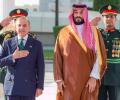
'Saudi-Pak defence pact is to anchor the defence and security of Saudi Arabia and not Pakistan, per se, with Islamabad being the junior partner.'

Aayush will represent India on Rosatom's Arctic expedition aboard the 50 Let Pobedy nuclear icebreaker.
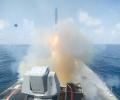
'India was not obliged to protect the Iranian ship.' 'Once the Iranian ship left Indian waters, she was on her own.' 'Guilt tripping India is wrong.'

'Was the five-day pause ever meant to hold, or was it simply another instrument of signaling, of positioning, of buying time in a war where even the pauses are tactical?' asks Prem Panicker in his must read daily blog on the Gulf War.
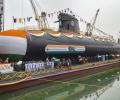
The status of the current submarine force level is alarming and we need to address the threat perceptions expeditiously. Critical decisions pertaining to national security cannot be delayed any further due to the rapidly changing maritime threat perceptions and growing strategic importance of the Indian Ocean region, asserts Commodore Venugopal Menon (retd).
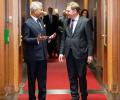
External Affairs Minister S Jaishankar has asserted that India has zero tolerance for terrorism and will never give in to nuclear blackmail, emphasizing that New Delhi will deal with Pakistan purely bilaterally. He made these remarks during a joint press conference with his German counterpart in Berlin, where he also highlighted the importance of the strategic partnership between India and Germany, emphasizing the need for a free trade agreement between the two nations.
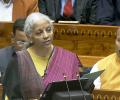
Budget 2026 sticks to fiscal discipline, shuns populist measures despite five key state elections coming up, but ends up rattling stock markets with a higher transaction tax on derivatives trading.

60 years ago, on January 24, 1966, Dr Homi J Bhabha, the father of India's nuclear programme, died in an air crash on Mont Blanc. The official inquiry said the plane went off course in bad weather, but coincidences, missing evidence, and later unproven claims have kept conspiracy theories alive. A fascinating excerpt from Bakhtiar Dadabhoy's book, Homi J Bhabha: A Life.

Vice President J D Vance has said that the United States hopes that India will respond to the Pahalgam terrorist attack in a way that does not lead to a 'broader regional conflict' and expects Pakistan to 'cooperate' with New Delhi to 'hunt down' militants sometimes operating from their soil.

The exit of Larsen & Toubro (L&T) from the Hyderabad Metro is a long-term positive for the stock. It could be a bullish trigger, alongside higher international orders, and new opportunities in segments like defence and data centres.

Drawing on December 2025 IMDb user ratings, we present a list of the most-highly rated shows of all time.
